Pages

Showing posts with label Art and Science. Show all posts

Saturday, January 16, 2016

Sound and Vision - Inner Space, Outer Space - R.I.P. David Bowie


Astronaut Chris Hadfield's "Space Oddity," in Space!  STEAM

But why mess with perfection? LYRICS are "And I think my Spaceship knows which way to go" & "Planet Earth is Blue and there's Nothing I can Do"


"The famous parade of personae that defined his astounding 1970s discography represented not just new sounds and aesthetics; Bowie was essentially a human Internet, with each album serving as a hyperlink into a vast network of underground music, avant-garde art, art-house film, and left-field literature. Bowie was the nexus through which many rock fans were first introduced to not just the Velvet Underground and the Stooges and Kraftwerk and Neu!, but also William S. Burroughs and Klaus Nomi and Nicolas Roeg and Ryuichi Sakamoto and Nina Simone. By design, most pop music is a closed loop—a rollercoaster that’s expertly designed for maximal thrills, to make you go “wheee!” over and over again. Bowie envisioned pop as Grand Central Station, the train tracks branching off into infinite new directions."

David Bowie’s Filthy Lesson

For Bowie, art was inauthenticity all the way down.

"Art’s filthy lesson is inauthenticity all the way down, a series of repetitions and reenactments: fakes that strip away the illusion of reality in which we live and confront us with the reality of illusion. Bowie’s world is like a dystopian version of The Truman Show, the sick place of the world that is forcefully expressed in the ruined, violent cityscapes of “Aladdin Sane” and “Diamond Dogs” and, more subtly, in the desolate soundscapes of “Warszawa” and “Neuköln.” To borrow Iggy Pop’s idiom from Lust for Life (itself borrowed from Antonioni’s 1975 movie, although Bowie might well be its implicit referent), Bowie is the passenger who rides through the city’s ripped backside, under a bright and hollow sky."

Read More... https://newrepublic.com/article/127430/david-bowies-filthy-lesson 

How David Bowie Challenged MTV on Race

 http://www.nytimes.com/2016/01/14/arts/music/how-david-bowie-used-his-stardom-and-race-to-challenge-mtv.html 

video: https://www.youtube.com/watch?v=XZGiVzIr8Qg


Bowie’s nine minute epic “Cygnet Committee” remains the undiscovered inner-Space Oddity from David’s 1969 self-titled debut album

https://dontforgetthesongs365.wordpress.com/2013/11/15/bowies-nine-minute-epic-cygnet-committee-remains-the-undiscovered-inner-space-oddity-from-davids-1969-self-titled-debut-album/

Cygnet Committee:
https://www.youtube.com/watch?v=OKMSgZo9c8s


Space Oddity Live - https://www.youtube.com/watch?v=pXSGocWifAg


Church Bells Ring Out 'Space Oddity' In Spine-Tingling David Bowie Tribute 

https://youtu.be/FHnKsixhGrg

Friday, March 20, 2015

Testimonial on an Observatory Project (Real Learning Can Happen Anywhere!)

“I always held a deep interest in Astronomy, but what I discovered while at the Observatory was my passion for and love of critical and out-of-the box strategic thinking and leadership. And that the greater the idea, project and best intentions, the more of a thorough and adaptable execution plan you need that can be broken up into bite sized pieces that people can run with and take ownership of. For example during the “Evolving New Ideas” event [for the Michigan Science Teachers Association at the Renaissance Ballroom in 1997 and for National in 1998] while volunteers may have wanted to setup technical infrastructure or interact with animals, the Zoo may have been seeking exposure and funding, while the school district had to show tangible value and sustainability and from the Observatory’s perspective, we were interested in the scalability of this model nationwide. You have to account for all of that plus possible conflicts of interest and the unexpected. ”


— Daniel Pesserl, Risk Operations Manager at Microsoft & Former Director of Technology at the McMath Hulbert Solar Observatory (from ages 17-25)


Sunday, March 15, 2015

Art and Science - What We DO! (videos on site)

Preview the Epic Dance Opera Filmed Inside CERN's Large Hadron Collider

SYMMETRY - dance & opera film inside CERN from TRUTH.IO on Vimeo.


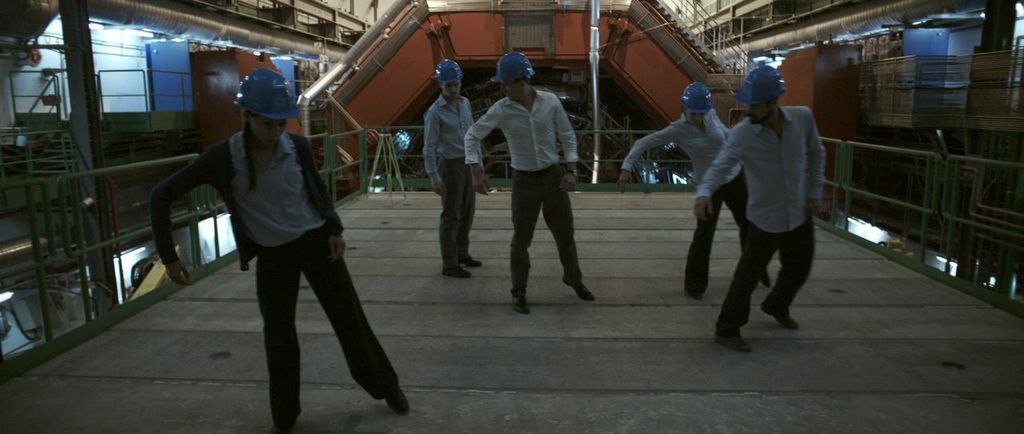
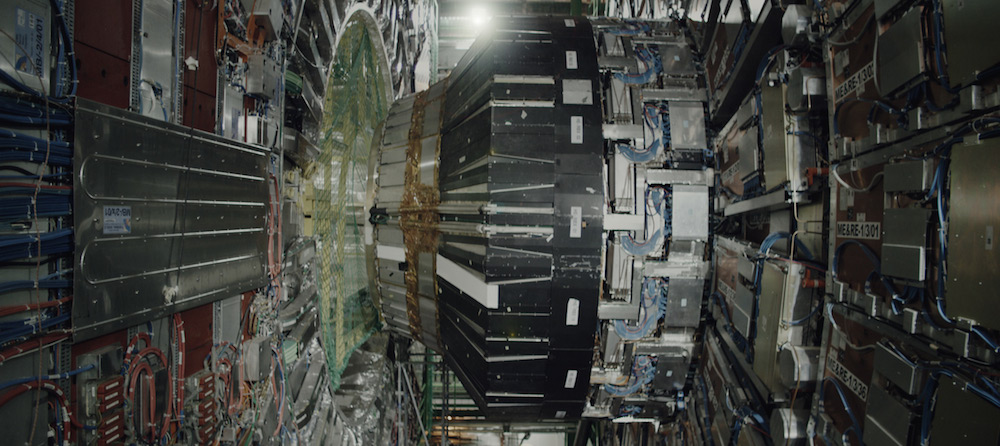
Inside CERN's Large Hadron Collider (LHC), the particle accelerator where scientists are studying the tiniest building blocks of the natural world and peering at the remnants of the explosive birth of our universe, an unlikely group of individuals in suits and construction helmets burst into dance. They are part of Symmetry, an upcoming film that fuses opera, choreography, digital art, and physics to tell a deeply existential tale around the basic questions asked by all curious humans: who are we? Where do we come from? Where are we going? Today, we’re premiering a teaser of the massive multimedia piece, above, which will be screened at the EYE Film Institute in Amsterdam on March 14 as part of the Cinedans film festival and at the NewScientist CERN festival later that same week.
Images courtesy the artist
“I didn’t want to make a documentary to explain or understand modern physics in general, but rather interpret the complex material this institution is presenting,” director Ruben van Leer tells The Creators Project. “And this is also what for me an opera film could do; give space for the audience to make up their own story, with their own imagination and make a journey like [the main character] within themselves: a tiny, personal, world changing quantum-story.” van Leer and his team wanted to research how they could connect multiple levels of movement, including music, sound, animation, data clouds, and camera work, into a single visual experience.
The first challenge van Leer faced was crafting a film script around dance, because he could find no precedents from his research. He met with choreographer Lukas Timulak, a former dancer for the Netherlands Dance Theater, and together they hammered out a story that would involve an inaugural dance performance inside CERN. Played by Timulak, the main character Lukas is a scientist/dancer who, when struck by an inner voice, played by soprano singer Claron McFadden, is suddenly thrown off balance from his rational studies. On a quest for a unifying theory, he is transported by McFadden’s voice into an alternate dimension, a “landscape of endless possibilities,” where she teaches him about the timelessness of dance, music, and love.
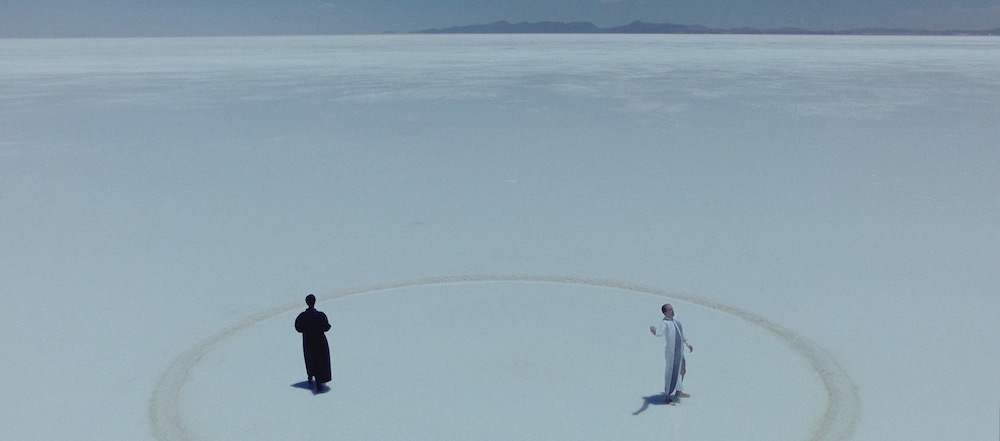
Bolivia's largest salt flat, Salar de Uyuni, is almost as high as the depth of CERN's detectors and colliders, says Van Leer, which makes for an incredible metaphorical contrast. In the film, once Lukas spins through the Collider, he ends up in the Uyuni mineral landscape, a pure, monotone, and serene plain that transforms the sky above into a mirror image. This is Lukas’ inner world, he adds, where he grapples with the decision between infinite love and the smallest particle.
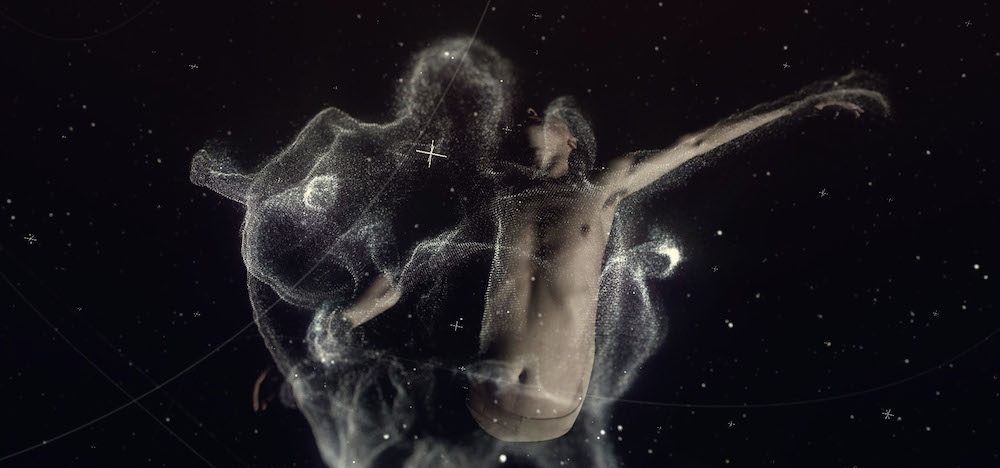
From Chris Nolan’s Interstellar, to images in Stephen Hawkings’ books, and to physics lectures by Richard Feynman, van Leer knit all of these influences together into the visual language for Symmetry. In addition, he and his team were drawn to the data visuals of CERN’s data, the digital animations of particle collisions. To bring that research into the artwork, van Leer collaborated with Berlin-based generative art studio OnFormative, who captured the dancers with six Kinect cameras and morphed them into a 3D data cloud of their bodies. Then, Belgium physicist Frederik VanHoutte created a tool to transcode the CERN data collisions into usable 3D paths of explosions and Tom Geraedts digitally animated the protagonist. The combination of visuals became representative of “greater insight.”
Art and science are similar worlds in that they are filled with uncertainty, yet at the same time, they are expanding creating endless new routes for exploration, explains Van Leer. At the same time, they’re also different: “[Scientists] can put forward a theory and insight with great conviction. But when they find out their theory was mistaken in the first place, they are also the first ones to admit, and go straight back to the drawing board to refine the idea. For artists this is really difficult. We got a big ego, and we need this ego to create and express ourselves.” The meaning and significance of the word “symmetry” in the two worlds was the perfect name for the film.
At the heart of Symmetry is the notion of time. van Leer feels that we're in an era where it no longer means the same thing. With big data and technological advances like the internet, time travel, in a certain sense, seems possible. With the film, he wanted to connect the past, ancient “primal arts” such as dance and song, with the future, contemporary scientific innovations. “Maybe time is just a memory. And stories set the mental clock,” he says.


Sunday, February 15, 2015

Science behind the Art and Practice of Network Weaving

How Networks Are Revolutionizing Scientific (and Maybe Human) Thought

The views expressed are those of the author and are not necessarily those of Scientific American.

Visualization of social network analysis. (Calvinius/Wikimedia Commons)
Science and common sense are alike grounded in human experience. Yet these ways of thinking about things are often in conflict. Sometimes the simplicity of most commonsense explanations can make it hard to win people over to the complexity and uncertainties of most scientific arguments.
Consider the textbook case of the mathematician and astronomer Nicolaus Copernicus (1473–1543). For centuries, making accurate predictions about where the planets would be on any given night was anything but a piece of cake. The irony is that the calculations involved were so challenging because everyone was accepting as the gospel truth the mistaken but commonsense idea that Earth sits motionless at the center of the universe while the sun, moon and planets move around us.

Nicolaus Copernicus. (Wikimedia Commons)
Similarly, the Darwinian revolution of the 19th century challenged not only the conviction that we live at the center of things, but also that we are the lead characters in the story of life on Earth. Many still do not accept Darwin’s insight that all life on our planet has evolved by means of natural selection.
In contrast to the cognitive revolutions triggered by Copernicus and Darwin, today’s seemingly pedestrian worries about issues such as net neutrality or Facebook privacy may seem inconsequential. Yet both are contemporary signs that there is another cognitive revolution in the making.
Modern research in sociology, psychology, neuroscience, and anthropology is showing that our world does not revolve around ourselves as individuals—contrary to Enlightenment and later claims that we are inherently self-centered creatures. Instead, what we are like as individuals critically depends on how we are linked socially and emotionally with others in relational networks reaching far and wide.
Why? We have evolved as a species to be quintessentially social creatures. Many plausible explanations have been proposed for why we are so. The bottom line, however, is a telling one. As the psychologists Lane Beckes and Jim Coanhave observed, being a social animal gives us real advantages in the struggle for existence—a social baseline of emotional support and security. So much so, that perhaps far more than most of us realize, our human connections with others are in effect an extension of the way our brain interacts with the world.
Science and philosophy today are grappling with some of the larger implications of this view of life. For instance, the anthropologist Fredrik Barth once remarked that practically all social science reasoning rests on the idea that there are discrete groups of people on Earth that can be variously labeled as populations, ethnic groups, societies, cultures, or races.
This commonsense understanding of human diversity—often called typological or categorical thinking—takes it as self-evident that things naturally come in different kinds, or types, that can be labeled as such. From this perspective, the words we use to describe things are like empty containers into which we can put things once we have grasped the essential “meaning” of these verbal containers.
Adopting a networks perspective, however, changes how we see the world and our place in it. Take the contentious issue of race. From a commonsense perspective, it seems obvious that different kinds of people live in different parts of the globe. Who could possibly mistake people from African, Asian or Irish descent? From a networks perspective, however, it is a no-brainer to see that everybody on Earth is linked with everyone else by “six degrees of separation.”

Six degrees of separation, artistic visualization. (Daniel/Wikimedia Commons)
Or consider why some of us are fatter than others. The commonsense answer is that some of us eat too much. But why? As part of the Framingham Heart Study, Nicholas Christakis and James Fowlerlearned using network approaches that individual weight gain in a social network of over 12,000 people was associated with weight gain in their spouses, friends, siblings and neighbors even beyond the level of direct social contact—people you have never met face to face may influence how well you keep to a desired weight.
Finally consider the spread of ideas via social networks. Common sense tells us that people with the strongest ties with others ought to be the most influential people to have around when, say, you are launching a new product or trying to convince others to accept a new idea. Network research, however, has shown that it is those who have weaker ties with others outside their immediate social circle who are actually in the best position to get the word out.
The impact of our social networks on our lives can be substantial. For example, close-knit groups having few ties with others beyond the immediate circle of friends, relatives or colleagues can become breeding grounds for odd and sometimes harmful ideas and practices—such as the contagious suicides reported among teenagers in places as culturally and geographically disparate as urban North Americaand Micronesia.
This shift in thinking is not only happening in the social sciences. Networks are also having a major impact in the biological and physical sciences. Take that well-known most basic unit of our biological selves, the gene. It has become common sense to think that genes encode everything from our hair color to our propensity for wearing rubber bands on our wrists. However, evolutionary biologists are now modeling series of complex networked relationships at multiple levels ranging from individual “letters” in the genome to protein-gene networks to interaction networks between organisms, thereby demonstrating that our genes are only our destinies to the extent that they link to each other and to the surrounding world—both social and natural.
Network thinking lets us scientifically understand the world around us as one of connections that shape observed phenomena, rather than as one where the intrinsic properties of people, genes, or particles determine outcomes. Like previous scientific revolutions, the network revolution also has the promise of reshaping our basic commonsense expectations of the world around us, and may allow us to recognize that we are not a basically individualistic, asocial, and quarrelsome creature that comes in bounded linguistic, ethnic, racial, or religious types, but a social species linked to one another by far-reaching network ties.
About the Author:
John Edward Terrell is Regenstein Curator of Pacific Anthropology at The Field Museum in Chicago, Illinois. His latest book A Talent for Friendship: Rediscovery of a Remarkable Trait will be published on December 1, 2014 by Oxford University Press.Termeh Shafie is a postdoctoral researcher in the Department of Computer & Information Science at University of Konstanz, Germany.
Mark Golitko is Regenstein Postdoctoral Fellow at The Field Museum in Chicago, Illinois. 

Tuesday, January 6, 2015

Leonardo Da Vinci's To Do List (ART and SCIENCE, GENERALISTS and SPECIALISTS)

Da Vinci’s Ghost: How The Vitruvian Man Came To Be

by 
Fifteen centuries of combinatorial creativity, or what Leonardo’s to-do list has to do with ancient Rome.
In the first century B.C., at the dawn of the Roman imperial age, the architect and thinkerVitruvius proposed that the human body could fit inside a circle, symbolic of the divine, and a square, associated with the earthly and secular — an idea that later became known as the theory of the microcosm, and came to power European religious, scientific, and artistic ideologies for centuries. Some fifteen hundred years later, in 1487, Leonardo da Vinci rediscovered Vitruvius’s theories and put them into form. Thus, the Vitruvian Manwas born — one of humanity’s most powerful, iconic, and enduring images, and a cornerstone of mapping the body, dominating visual culture in everything from books to billboards. Yet its story is far more complex than that, and its enigma far richer than a handful of historical factoids. This is exactly what Toby Lester unravels in Da Vinci’s Ghost: Genius, Obsession, and How Leonardo Created the World in His Own Image — a fascinating century-wide saga that explores how Leonardo set out to expand the metaphysical horizons of his art by studying the proportions and anatomy of the human body and its relationship with the cosmos, and ultimately created a visceral impression of Renaissance thought itself in the process.
Lester observes:
At a superficial level, [Vitruvian Man] is simply a study of individual proportions. But it’s also something far more subtle and complex. It’s a profound act of philosophical speculation. It’s an idealized portrait in which Leonardo, stripped down to his essence, takes his own measure and, in doing so, embodies a timeless human hope: that we just might have the power of mind to figure out how we fit into the grand scheme of things.”
The story, spanning a wealth of disciplines, cultures, and eras, unfolds through two parallel threads — one tracing Leonardo’s individual journey, and one weaving together the collective narrative of the people and ideas who filled and filtered the fifteen centuries between Vitruvius and Da Vinci. Among them are ancient Greek sculptors, early Christian and Muslim philosophers, Renaissance architects and anatomists, and Poggio Bracciolini, the book-hunter credited with starting the Renaissance.
Leonardo was also a voracious information omnivore, a quality so fundamental to the very networked knowledge and combinatorial creativity that no doubt enabled him to create the Vitruvian Man. He always carried a notebook with him and was known to have owned at least 45. Lester writes of the journals:
These notes reveal Leonardo in his perpetually ravenous information-gathering mode. Benedictine monks, obscure medieval treatises, university professors, popular guidebooks, accountants, itinerant merchants, foreign diplomats, artillerymen, military engineers, waterworks experts: all are fair game to him as he hunts for information about subjects that interest him.”
To complement Robert Krulwich’s NPR story about the book, my supremely talented friend Wendy MacNaughton (remember her?) drew this lovely illustrated to-do list based on a page from one of Da Vinci’s notebooks circa the 1490s:
More than a treasure trove of historical ephemera — though it certainly is that, with its generous selection of rare archival images that capture the evolution of Vitruvian Man — Da Vinci’s Ghost is also a profound reflection on humanity’s timeless obsession with untangling the intricate relationship between the physical and the metaphysical in our quest to better understand what we are and where we belong in the universe.
Complement with the psychology of what makes a to-do list successful.