HOLONOMY: the science of interacting parts within wholes.
Holos = Whole.
On = Part.
Nomy = Systematized Knowledge.
The Study or Science of Wholeness.
The balance between Self-Assertion and Integration.
A strategy called “design thinking” has helped numerous entrepreneurs and engineers develop successful new products and businesses. But can design thinking help you create healthful habits?
Bernard Roth, a prominent Stanford engineering professor, says that design thinking can help everyone form the kind of lifelong habits that solve problems, achieve goals and help make our lives better.
“We are all capable of reinvention,” says Dr. Roth, a founder of the Hasso Plattner Institute of Design at Stanford and author of the book, “The Achievement Habit.”
I’ve applied design thinking to my own life the past few months, and it seems to be working. I’ve lost 25 pounds, reconnected with close friends and refocused my energy on specific goals and habits.
Design thinking has helped me identify the obstacles that were stopping me from achieving my goals, and it’s helped me reframe my problems to make them easier to solve.
In the words of Dr. Roth, design thinking helped me “get unstuck.”
To get started, design thinkers focus on five steps, but the first two are the most important. Step 1 is to “empathize” — learn what the real issues are that need to be solved. Next, “define the problem” — a surprisingly tough task. The third step is to “ideate” — brainstorm, make lists, write down ideas and generate possible solutions. Step 4 is to build a prototype or create a plan. The final step is to test the idea and seek feedback from others.
Design thinking is normally applied by people who are trying to create a new product or solve a social problem or meet a consumer need.
For instance, Stanford students went to Myanmar to work on an irrigation project. The first two steps of design thinking — empathize and define the problem — meant that the students spent time with the farmers to understand their problems with watering crops.
In doing so, they discovered that the farmers’ real problem was not irrigation but light. The farmers used candles or kerosene lanterns, and the fumes filled their small huts. Managing their needs for light without electric power consumed a great deal of time and income.
As a result, the design-thinking students used empathy to shift their focus to the actual problem that needed solving. They developed affordable, solar-powered LED task lights. They have since provided millions of lights to 42 countries, creating an affordable lighting solution in parts of the world that don’t have electricity, or have spotty service.
Dr. Roth says the same type of thinking that solved the lighting problem for the poor farmers can be applied inward. To start, think about the problem you want to solve. Then ask yourself, “What would it do for me if I solved this problem?”
One example Dr. Roth uses is a person who wants to find a life partner. Ask yourself, “What would finding a partner or spouse do for me?” One answer might be that it would bring you companionship. The next step is to reframe the problem: “How can I find companionship?” There are more and easier answers to the new question — you can meet friends online, take classes, join a club, take a group trip, join a running group, get a pet and spend time at the dog park.
“Finding a spouse now becomes simply one of many possible ways to find companionship,” Dr. Roth says. “By changing the question, I have altered my point of view and dramatically expanded the number of possible solutions.”
For years, I would have told you that my biggest problem was being overweight, but I simply could not find a diet that worked. But design thinking helped me reframe my problem.
It happened a few months ago when I declined an invitation to a party with many of my favorite people who I hadn’t seen in years. I didn’t go because I was embarrassed by my weight, and I just didn’t feel up to seeing people who knew me when I was thinner. I realized that my issues with my weight were getting in the way of me living my life.
It was time for design thinking. At this point, a design thinker would ask “What would losing weight really do for you?”
The answer surprised me. I wanted to feel better about myself, feel less tired and have more energy and confidence to socialize and reconnect with friends. Conducting my own personal empathy exercise helped me realize that weight loss was really not my problem. Instead, I needed to focus on my friendships, on boosting my energy and getting better sleep.
So reconnecting with friends and getting better sleep became my focus. I bought new clothes,
which made it easier to make social plans.
What the Heck is Design Thinking Anyway?
or How to Creatively and Consistently Solve Any Challenge Set Before You
If we define design as the decisions that determine how something works,
Design = Decisions
then Design Thinking is simply the process to make more thoughtful decisions.
Design Thinking = Thoughtful Decisions
Too often, we aren’t even aware there are decisions to be made, or that we have options besides the default on offer.
The
truth is, though — every day, in life and in work — you have a dizzying
array of opportunities to make more intentional decisions that could
result in more desirable outcomes.
Then why don’t we take advantage of this all-you-can-eat design buffet? Because there are too many opportunities.
How do we know which ones to take advantage of?
And even if we could figure that out, how exactly do we take advantage of them?
CUT TO: Design Thinking shyly raising its hand. 👋
Over
the years, this thought process has grown beyond its roots, primarily
in product design, to be applied universally to solve any problem
creatively — big, small, and seemingly impossible.
It’s as close to a human superpower as we have.
Seriously.
If science is how we make sense of our world, design is the way we impact it.
With Design Thinking you have the power to consistently harness creativity and make it your bitch.
Many
of us don’t believe creativity can be harnessed like other, more
earthly processes. Maybe that’s because until very recently in human
history, we haven’t had a creative-problem solving process that could be
as universally and consistently applied to do so.
Plus,
it’s much more fun to believe in a fickle and elusive muse who visits
only a select few, very special people in each lifetime.
When it comes down to it, creativity is simply the act of creating. Even if the thing you create exists only in your mind.
We can get paralyzed thinking that expressing creativity has to mean creating something that’s never existed before, EVER!
But that’s impossible. We cannot imagine the unimaginable.
Go ahead and try. We’ll wait.
(And no cheating by using our world’s laws of physics or any chemical element found in this universe!)
When
I was a kid, I spent a whole afternoon trying to draw what a real alien
would look like if it didn’t look like anything I’d ever seen before.
The best I came up with that day was putting boobs where the arms should
go.
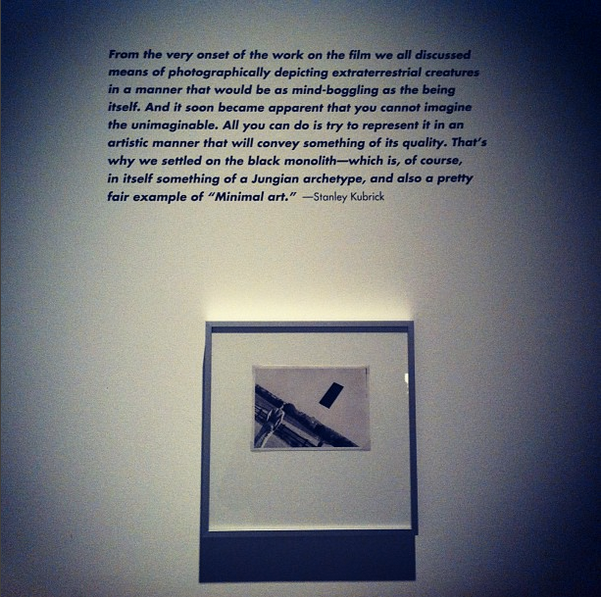
And then many years later, I saw this Stanley Kubrick quote at LACMA and was like, “Yes!”
“…it soon became apparent that you cannot imagine the unimaginable.” — Stanley Kubrick
We can only knit together what we already know in new ways to get to the something that’s never existed before.
Then, only in hindsight, can we look back and see that, nope, we never could have imagined the solution at the start.
And that’s what Design Thinking offers — a way to get where you’re going when you don’t know where that is.
So, what is the process of Design Thinking exactly?
Like anything, there’s complexity and layers of nuance to discover, but it can be pretty much summed up in four phases.
The 4 Phases of Design Thinking
1) Getting Focused:
This is all about identifying constraints, and framing your challenge
around the right questions (which probably aren’t the same questions
you’ve been knocking your head against forever).
Less like: How can we stop drinking so much wine in front of the TV every night, OMG, we’re such losers!?
More like: How might we design activities at home that help us feel rewarded after a hard day of work?
A
famous example of looking to an analogous situation is the redesign of a
hospital operating room that looked to a NASCAR pit crew for insights.
2) Getting Inspired:
This is all about letting your curiosity guide you, and gaining empathy
for the people you’re designing for (which could also be yourself).
Become a detective of the world outside your own. You’re looking for
clues about new ways of thinking and doing.
Talk
to experts, people with extreme behaviors related to your challenge,
and analogous situations that might provide unexpected answers. Go
crazy, think broadly, have fun with it, be a little weird. This isn’t
about finding the right answer. It’s about shaking things up and
collecting a swirl of many potential answers.
3) Getting Scrappy:
This is all about finding the patterns in your inspiration research,
generating a whole lot of wild ideas, and creating lo-fi prototypes.
4) Getting Smarter:
This is all about sharing your ideas with the people you’re designing
for early and often, and testing and iterating your way towards a
successful solution.
It
helps when you’re just getting started to use these like you would
training wheels, and to surround yourself with people who can do this
kind of work in their sleep. But once you get practiced at it, you
really don’t need to work through all the phases all the time, or do
them in any particular order.
In fact, approaching the world through a designer’s lens becomes more of a mindset — one that is centered around:
· Curiosity: to
seek out and see the world in new ways, especially through the eyes of
other people. Empathy is an especially powerful tool, used in
combination with your own design instincts.
· Optimism:
to feel like every challenge is an opportunity for improvement, and
that people (including you!) have the capacity to identify and solve
seemingly impossible problems.
· Collaboration:
to surround yourself with people whose brains and skills are different
than yours so that you incorporate new perspectives and can get further
faster, together.
One
word of caution, like with all superpowers, you’ll sometimes resent
experiencing the world with this newfound hyper-sensitivity.
Like
when you’re at the airport at a United gate and everyone is asking
everyone else if they’re standing in line 2 or 3 or what group is
boarding, and people are bunched up against the moving sidewalk barriers
and nobody walking by can get through and you’re like, “You can design
this process to actually function if you wanted to, stupid f*cking
United!”
By
the way, that’s a good distinction to make: optimism doesn’t mean being
cloyingly rose-colored. It just means you believe there’s room for
improvement. And being design-minded just means you have the creative
confidence that you are one of those people who can improve it.
I’m definitely optimistic that you can!
I’m also curious to hear what design challenges you’re interested in solving.
Share them here, and who knows, maybe there are others reading this that would be great collaborators on your new project.
If you want to experiment with applying design thinking to your own life, listen and subscribe to the Results May Vary podcast.
And
if you enjoyed this article, please tap the heart below and share with
someone you think would enjoy designing their lives more mindfully.
DO some people have a special talent for serendipity? And if so, why?
In
2008, an inventor named Steve Hollinger lobbed a digital camera across
his studio toward a pile of pillows. “I wasn’t trying to make an
invention,” he said. “I was just playing.” As his camera flew, it
recorded what most of us would call a bad photo. But when Mr. Hollinger
peered at that blurry image, he saw new possibilities. Soon, he was
building a throwable videocamera in the shape of a baseball, equipped
with gyroscopes and sensors. The Squito (as he named it) could be rolled
into a crawlspace or thrown across a river — providing a record of the
world from all kinds of “nonhuman” perspectives. Today, Mr. Hollinger
holds six patents related to throwable cameras.
A
surprising number of the conveniences of modern life were invented when
someone stumbled upon a discovery or capitalized on an accident: the
microwave oven, safety glass, smoke detectors, artificial sweeteners,
X-ray imaging. Many blockbuster drugs of the 20th century emerged
because a lab worker picked up on the “wrong” information.
While
researching breakthroughs like these, I began to wonder whether we can
train ourselves to become more serendipitous. How do we cultivate the
art of finding what we’re not seeking?
For
decades, a University of Missouri information scientist named Sanda
Erdelez has been asking that question. Growing up in Croatia, she
developed a passion for losing herself in piles of books and yellowed
manuscripts, hoping to be surprised. Dr. Erdelez told me that Croatian
has no word to capture the thrill of the unexpected discovery, so she
was delighted when — after moving to the United States on a Fulbright
scholarship in the 1980s — she learned the English word “serendipity.”
Today we think of serendipity as something like dumb luck. But its original meaning was very different.
In
1754, a belle-lettrist named Horace Walpole retreated to a desk in his
gaudy castle in Twickenham, in southwest London, and penned a letter.
Walpole had been entranced by a Persian fairy tale about three princes
from the Isle of Serendip who possess superpowers of observation. In his
letter, Walpole suggested that this old tale contained a crucial idea
about human genius: “As their highnesses travelled, they were always
making discoveries, by accident and sagacity, of things which they were
not in quest of.” And he proposed a new word — “serendipity” — to
describe this princely talent for detective work. At its birth,
serendipity meant a skill rather than a random stroke of good fortune.
Dr. Erdelez agrees with that definition. She sees serendipity as something people do.
In the mid-1990s, she began a study of about 100 people to find out how
they created their own serendipity, or failed to do so.
Her
qualitative data — from surveys and interviews — showed that the
subjects fell into three distinct groups. Some she called
“non-encounterers”; they saw through a tight focus, a kind of chink
hole, and they tended to stick to their to-do lists when searching for
information rather than wandering off into the margins. Other people
were “occasional encounterers,” who stumbled into moments of serendipity
now and then. Most interesting were the “super-encounterers,” who
reported that happy surprises popped up wherever they looked. The
super-encounterers loved to spend an afternoon hunting through, say, a
Victorian journal on cattle breeding, in part, because they counted on
finding treasures in the oddest places. In fact, they were so addicted
to prospecting that they would find information for friends and
colleagues.
You
become a super-encounterer, according to Dr. Erdelez, in part because
you believe that you are one — it helps to assume that you possess
special powers of perception, like an invisible set of antennas, that
will lead you to clues.
A
few months ago, I was having a drink in Cambridge, Mass., with a
friend, a talented journalist who was piecing together a portrait of a
secretive Wall Street wizard. “But I haven’t found the real story yet;
I’m still gathering string,” my friend told me, invoking an old newsroom
term to describe the first stage of reporting, when you’re looking for
something that you can’t yet name. Later that night, as I walked home
from the bar, I realized “gathering string” is just another way of
talking about super-encountering. After all, “string” is the stuff that
accumulates in a journalist’s pocket. It’s the note you jot down in your
car after the interview, the knickknack you notice on someone’s shelf,
or the anomaly that jumps out at you in Appendix B of an otherwise
boring research study.
As
I navigated the brick sidewalk, passing under the pinkish glow of a
streetlight, I thought about how string was probably hiding all around
me. A major story might lurk behind the Harvard zoology museum ahead or
in the plane soaring above. String is everywhere for the taking, if you
have the talent to take it.
In
the 1960s, Gay Talese, then a young reporter, declared that “New York
is a city of things unnoticed” and delegated himself to be the one who
noticed. Thus, he transformed the Isle of Manhattan into the Isle of
Serendip: He traced the perambulations of feral cats, cataloged
shoeshine purveyors, tracked down statistics related to the bathrooms at
Yankee Stadium and discovered a colony of ants at the top of the Empire
State Building. He published his findings in a little book titled “New
York: A Serendipiter’s Journey.”
The
term “serendipiter” breathed new life into Walpole’s word, turning
serendipity into a protagonist and a practitioner. After all, those ants
at the top of the Empire State Building didn’t find themselves; Mr.
Talese had to notice them, which was no easy matter. Similarly, Dr.
Erdelez came up with the term super-encounterer to give us a way to talk
about the people rather than just the discoveries. Without
such words, we tend to become dazzled by the happy accident itself, to
think of it as something that exists independent of an observer.
We
can slip into a twisted logic in which we half-believe the penicillin
picked Alexander Fleming to be its emissary, or that the moons of
Jupiter wanted to be seen by Galileo. But discoveries are products of
the human mind.
As
people dredge the unknown, they are engaging in a highly creative act.
What an inventor “finds” is always an expression of him- or herself.
Martin Chalfie, who won a Nobel Prize for his work connected with green
fluorescent protein — the stuff that makes jellyfish glow green — told
me that he and several other Nobel Prize winners benefited from a chain
of accidents and chance encounters on the way to their revelations. Some
scientists even embrace a kind of “free jazz” method, he said,
improvising as they go along: “I’ve heard of people getting good results
after accidentally dropping their experimental preparations on the
floor, picking them up, and working on them nonetheless,” he added.
So
how many big ideas emerge from spills, crashes, failed experiments and
blind stabs? One survey of patent holders (the PatVal study of European
inventors, published in 2005) found that an incredible 50 percent of
patents resulted from what could be described as a serendipitous
process. Thousands of survey respondents reported that their idea
evolved when they were working on an unrelated project — and often when
they weren’t even trying to invent anything. This is why we need to know
far more about the habits that transform a mistake into a breakthrough.
IN
the late 1980s, Dr. John Eng, an endocrinologist, became curious about
certain animal poisons that damaged the pancreas, so he ordered lizard
venom through the mail and began to play around with it. As a result of
this curious exercise, he discovered a new compound in the saliva of a
Gila monster, and that in turn led to a treatment for diabetes. One of
Dr. Eng’s associates (quoted in a 2005 newspaper article) remarked that
he was capable of seeing “patterns that others don’t see.”
Is
this pattern-finding ability similar to the artistic skill of a painter
like Georgia O’Keeffe? Is it related to the string-gathering prowess of
Gay Talese? We still know so little about creative observation that
it’s impossible to answer such questions.
That’s
why we need to develop a new, interdisciplinary field — call it
serendipity studies — that can help us create a taxonomy of discoveries
in the chemistry lab, the newsroom, the forest, the classroom, the
particle accelerator and the hospital. By observing and documenting the
many different “species” of super-encounterers, we might begin to
understand their minds.
A
number of pioneering scholars have already begun this work, but they
seem to be doing so in their own silos and without much cross-talk. In a
2005 paper (“Serendipitous Insights Involving Nonhuman Primates”), two
experts from the Washington National Primate Research Center in Seattle
cataloged the chance encounters that yielded new insights from creatures
like the pigtail macaque.
Meanwhile, the authors of a paper titled “On
the Exploitation of Serendipity in Drug Discovery” puzzled over the
reasons the 1950s and ’60s saw a bonanza of breakthroughs in psychiatric
medication, and why that run of serendipity ended. And in yet another
field of study, a few information scientists are trying to understand
the effects of being bombarded on social media sites with countless
tantalizing pieces of “string.”
What could these researchers discover if they came together for one big conversation?
Of
course, even if we do organize the study of serendipity, it will always
be a whimsical undertaking, given that the phenomenon is difficult to
define, amazingly variable and hard to capture in data. The clues will
no doubt emerge where we least expect them, perhaps in the fungi
clinging to the walls of parking garages or the mating habits of
bird-watchers. The journey will be maddening, but the potential insights
could be profound: One day we might be able to stumble upon new and
better ways of getting lost.
Pagan Kennedy is the author of the forthcoming book “Inventology: How We Dream Up Things That Change The World.”
The State Board of Education approved new science standards Tuesday that will alter the way students are taught the subject, while the Michigan Department of Education put changes to social studies standards on hold.
The change in the science standards means there will be greater emphasis on thinking and acting like a scientist and less emphasis on memorizing basic facts. The idea is for students to have a deeper knowledge of the subject.
State education officials believe the change will improve Michigan students’ dismal performance in the subject. Results of the state’s new exam — the Michigan Student Test of Educational Performance (M-STEP) — found that only 12% of fourth-graders and 22% of fifth-graders passed the science portion of the exam.
Those numbers “reflect the fact that what we’re doing today may not be working as well as we want,” said Casandra Ulbrich, D-Rochester Hills, the board’s vice president.
The new standards — a slight adaptation of the nationally created Next Generation Science Standards — were approved by a vote of 7-1, with the only dissenting vote coming from Richard Zeile, R-Dearborn.
The board heard mixed views about the science standards from a stream of parents and educators.
Critics said the standards are unproven and cited a report that gave them an average grade.
“Why are we moving in a lateral, slightly lower direction instead of up?” asked Michelle Frederick of White Lake Township.
But they were countered by people like Emily Pohlonski, president of the Network of Michigan Educators, who spoke about how the standards will affect her daughter, who will enter third grade next school year. Under the current standards, her daughter would simply have to identify the force that holds objects to the Earth. But under the new standards, her daughter would have to plan and conduct an investigation to provide evidence of the effects of balance and unbalanced forces on the motion of an object.
“Let’s pay attention to the verbs. Do we want our kids identifying ... or do we want our kids planning and investigating?”
Meanwhile, MDE said it was delaying updates to the standards for social studies to address concerns raised by Michigan residents.
“We’re not going to rush it. We’re going to get it right,” state Superintendent Brian Whiston said during the meeting.
Both sets of standards outline expectations for what students will learn. It will be up to local schools to determine how to teach them.
The MDE has already addressed some big criticisms. For instance, the standards referred to the U.S. as a “constitutional democracy” rather than as a “constitutional republic.” The MDE said the standards have already been revised to make that correction.
The state also made some changes to address concerns it appeared to be dropping the study of World War II, the Holocaust and the establishment of the State of Israel.
The proposed social studies and science standards were both sent out for public feedback from late August to early October.
About 74% of the 450 people who responded to a survey said they believed students would be better prepared under the proposed update to the social studies standards. But 26% didn’t agree. While that’s a relatively low number statistically, MDE said it was too high.
“That’s something that needs to be looked at and considered,” said
Linda Forward, director of the office of education improvement and innovation at MDE.
The update — to standards last approved by the board in 2007 — was designed to reduce the number of social studies standards from 652 to 552, make them more concise and make them more rigorous, emphasizing students’ ability to apply what they’re learning to real-world situations and focusing more on completing projects.
The changes will align Michigan’s standards with those developed by the National Council for the Social Studies.
The department will address all concerns, then put together an external committee to review the changes. A new public comment period will take place after the beginning of the year, and the standards likely will go before the State Board in February.
State Sen. Patrick Colbeck, R-Canton, provided more than a dozen recommendations to the social studies standards.
“My goal is to make sure we’re presenting both sides of the story.” For instance, he said, “When we talk about progressiveness, why aren’t we talking about conservatism?” The goal, Colbeck said, should be to give kids the tools “so they can make decisions on their own.”
John Austin, president of the board, said it can be difficult to find balance in a subject such as social studies because there are often “warring viewpoints” about topics covered. It’s the responsibility of the board and MDE to “get that balance as good as possible.”
“I’m glad we’re taking the time to do this,” said Austin, D-Ann Arbor.
Technology alone can't educate students. It’s not some mystical, magical ingredient one sprinkles over core curricula like salt on a meal. The magic is inside the child. If designed correctly, technology only extends the creative powers of the individual. Technology needn’t be “high-tech” to be effective, either. Chalk on a graphite board is one of the earliest forms of technology in the classroom; a printed book is a kind of machine; a magnifying glass is technology for investigation of the natural world; string is a tool for building things.
A Pedagogy of Answers
Too many schools apply a paint-by-numbers approach to tech: “Let’s cover this fixed information, in this exact way, in this set amount of time, and judge ourselves as educators and students based on standardized test results.” Even our national conversation about the education crisis in the STEM subjects(science, technology, engineering, and math) focuses almost solely on America’s competitiveness on the world stage and students’ qualifications for the job market of tomorrow. That stagnant conversation has leeched much of the joy, magic, and love of learning from the study of those subjects and replaced it with an R.O.I. model of education.
Take Los Angeles’s plan to put iPads into the hands of each of its 650,000 students, which was a complete disaster; the nation’s second largest school district demanded a refund from Apple and Pearson, the company that designed the $1.3 billion curriculum. The mistake made in L.A. is that the city’s iPad experiment focused on answers: information, knowledge, skills, and tests. Children don’t learn that way.
To date, tech in the classroom has been used mostly to prettify an outdated model of passive learning. Examples of this kind of misapplication might be, “Let’s take the latest laptop computer and put a flashcard app on it!” Or, “Let’s make a math game where kids shoot at the right answer like they’re space aliens!” That kind of tech in the classroom hasn’t worked because it simply propagates into new mediums a broken model of how people learn.
A Pedagogy of Questions
Our national teaching model has for too long been a pedagogy of answers. In its place
I’d like to suggest a new pedagogy of questions—one that prizes interest-driven, project-based, exploratory studies. Personal gardens of learning with no single pathway through them. More open play and less rote memorization. More learning by discovery than following set instructions. (It’s for these reasons I’d always choose a bucket of random Legos over a manual to build a colored-brick Batmobile or Death Star. . . ) And technology has an important part to play in making that vision a reality. Let’s imagine for a moment a classroom where children are encouraged to:
1. Go about and wander until a salient question arises.
2. Paint and model and code solutions or experiments or musings to dig deeper into the questions raised.
3. Build things and try them out, politically, socially, or physically.
4. Share and modify results.
That school environment can exist today with the tools at hand. As an inventor and
father, my advice to those looking to make digital in-roads into our nation’s schools is this: promote learning that encourages kids to choose their own problems and solutions rather than a single, siloed system. Rewards are inherent if students find novel ways to use the technology with which they’re presented; friendships are stoked, and the technology is now owned and created by them rather than the other way around. Embrace the fact that students might find ways to hack the tools you present them; if you expect it then you have created space for it to happen. Finally, tactile learning is too often overlooked in digital classroom initiatives, so think about what a student’s hands will be doing when using technology.
Just as new media have not replaced our fundamental need to tell stories, invent characters, and instill moral lessons, so technology in the classroom will always be an aid for learning, never an end in itself. Putting the right tools in kids’ hands can help children explore the world they know and reinforce that “magic” is the silent “M” in STEM. Tech isn’t the answer, but it can help us create a new pedagogy of questions.
Jay Silver is an electrical engineer, toy inventor, and founder and CEO of JoyLabz, makers of Makey Makey, the invention kit for everyone.
Fareed Zakaria, a columnist for The Washington Post, is the host of “Fareed Zakaria GPS” on CNN and the author of “In Defense of a Liberal Education.”
If Americans are united in any conviction these days, it is that we urgently need to shift the country’s education toward the teaching of specific, technical skills. Every month, it seems, we hear about our children’s bad test scores in math and science — and about new initiatives from companies, universities or foundations to expand STEM courses (science, technology, engineering and math) and deemphasize the humanities. From President Obama on down, public officials have cautioned against pursuing degrees like art history, which are seen as expensive luxuries in today’s world. Republicans want to go several steps further and defund these kinds of majors. “Is it a vital interest of the state to have more anthropologists?” asked Florida’s Gov. Rick Scott. “I don’t think so.” America’s last bipartisan cause is this: A liberal education is irrelevant, and technical training is the new path forward. It is the only way, we are told, to ensure that Americans survive in an age defined by technology and shaped by global competition. The stakes could not be higher.
This dismissal of broad-based learning, however, comes from a fundamental misreading of the facts — and puts America on a dangerously narrow path for the future. The United States has led the world in economic dynamism, innovation and entrepreneurship thanks to exactly the kind of teaching we are now told to defenestrate. A broad general education helps foster critical thinking and creativity. Exposure to a variety of fields produces synergy and cross fertilization. Yes, science and technology are crucial components of this education, but so are English and philosophy. When unveiling a new edition of the iPad, Steve Jobs explained that “it’s in Apple’s DNA that technology alone is not enough — that it’s technology married with liberal arts, married with the humanities, that yields us the result that makes our hearts sing.”
Innovation is not simply a technical matter but rather one of understanding how people and societies work, what they need and want. America will not dominate the 21st century by making cheaper computer chips but instead by constantly reimagining how computers and other new technologies interact with human beings.
For most of its history, the United States was unique in offering a well-rounded education. In their comprehensive study,“The Race Between Education and Technology,”Harvard’s Claudia Goldin and Lawrence Katz point out that in the 19th century, countries like Britain, France and Germany educated only a few and put them through narrow programs designed to impart only the skills crucial to their professions. America, by contrast, provided mass general education because people were not rooted in specific locations with long-established trades that offered the only paths forward for young men. And the American economy historically changed so quickly that the nature of work and the requirements for success tended to shift from one generation to the next. People didn’t want to lock themselves into one professional guild or learn one specific skill for life.
That was appropriate in another era, the technologists argue, but it is dangerous in today’s world. Look at where American kids stand compared with their peers abroad. The most recent international test, conducted in 2012, found that among the 34 members of the Organization for Economic Cooperation and Development, the United Statesranked27th in math, 20th in science and 17th in reading. If rankings across the three subjects are averaged, the United States comes in 21st, trailing nations such as the Czech Republic, Poland, Slovenia and Estonia.
In truth, though, the United States has never done well on international tests, and they are not good predictors of our national success. Since 1964, when the first such exam was administered to 13-year-olds in 12 countries, America has lagged behind its peers, rarely rising above the middle of the pack and doing particularly poorly in science and math. And yet over these past five decades, that same laggard country has dominated the world of science, technology, research and innovation.
Consider the same pattern in two other highly innovative countries, Sweden and Israel. Israel ranks first in the world in venture-capital investments as a percentage of GDP; the United States ranks second, and Sweden is sixth, ahead of Great Britain and Germany. These nations do well by most measures of innovation, such as research and development spending and the number of high-tech companies as a share of all public companies. Yet all three countries fare surprisingly poorly in the OECD test rankings. Sweden and Israel performed even worse than the United States on the 2012 assessment, landing overall at 28th and 29th, respectively, among the 34 most-developed economies.
But other than bad test-takers, their economies have a few important traits in common: They are flexible. Their work cultures are non-hierarchical and merit-based. All operate like young countries, with energy and dynamism. All three are open societies, happy to let in the world’s ideas, goods and services. And people in all three nations are confident — a characteristic that can be measured. Despite ranking 27th and 30th in math, respectively, American and Israeli students came out at the top in their belief in their math abilities, if one tallies up their responses to survey questions about their skills. Sweden came in seventh, even though its math ranking was 28th.
Thirty years ago, William Bennett, the Reagan-era secretary of education, noticed this disparity between achievement and confidence and quipped, “This country is a lot better at teaching self-esteem than it is at teaching math.” It’s a funny line, but there is actually something powerful in the plucky confidence of American, Swedish and Israeli students. It allows them to challenge their elders, start companies, persist when others think they are wrong and pick themselves up when they fail. Too much confidence runs the risk of self-delusion, but the trait is an essential ingredient for entrepreneurship.
My point is not that it’s good that American students fare poorly on these tests. It isn’t. Asian countries like Japan and South Korea have benefitted enormously from having skilled workforces. But technical chops are just one ingredient needed for innovation and economic success. America overcomes its disadvantage — a less-technically-trained workforce — with other advantages such as creativity, critical thinking and an optimistic outlook. A country like Japan, by contrast, can’t do as much with its well-trained workers because it lacks many of the factors that produce continuous innovation.
Americans should be careful before they try to mimic Asian educational systems, which are oriented aroundmemorization and test-taking. I went through that kind of system. It has its strengths, but it’s not conducive to thinking, problem solving or creativity. That’s why most Asian countries, from Singapore to South Korea to India, are trying to add features of a liberal education to their systems. Jack Ma, the founder of China’s Internet behemoth Alibaba, recently hypothesizedin a speechthat the Chinese are not as innovative as Westerners because China’s educational system, which teaches the basics very well, does not nourish a student’s complete intelligence, allowing her to range freely, experiment and enjoy herself while learning: “Many painters learn by having fun, many works [of art and literature] are the products of having fun. So, our entrepreneurs need to learn how to have fun, too.”
No matter how strong your math and science skills are, you still need to know how to learn, think and even write. Jeff Bezos, the founder of Amazon (and the owner of this newspaper), insists that his senior executives write memos, often as long as six printed pages, and begins senior-management meetings with a period of quiet time, sometimes as long as 30 minutes, while everyone reads the “narratives” to themselves and makes notes on them. In an interview with Fortune’s Adam Lashinsky, Bezos said: “Full sentences are harder to write. They have verbs. The paragraphs have topic sentences. There is no way to write a six-page, narratively structured memo and not have clear thinking.”
Companies often prefer strong basics to narrow expertise. Andrew Benett, a management consultant, surveyed 100 business leaders and found that 84 of them said they would rather hire smart, passionate people, even if they didn’t have the exact skills their companies needed.
Innovation in business has always involved insights beyond technology. Consider the case of Facebook. Mark Zuckerberg was a classic liberal arts student who also happened to be passionately interested in computers. He studied ancient Greek intensively in high school and majored in psychology while he attended college. And Facebook’s innovations have a lot to do with psychology. Zuckerberg has often pointed out that before Facebook was created, most people shielded their identities on the Internet. It was a land of anonymity. Facebook’s insight was that it could create a culture of real identities, where people would voluntarily expose themselves to their friends, and this would become a transformative platform. Of course, Zuckerberg understands computers deeply and uses great coders to put his ideas into practice, but as he has put it, Facebook is “as much psychology and sociology as it is technology.”
Twenty years ago, tech companies might have survived simply as product manufacturers. Now they have to be on the cutting edge of design, marketing and social networking. You can make a sneaker equally well in many parts of the world, but you can’t sell it for $300 unless you’ve built a story around it. The same is true for cars, clothes and coffee. The value added is in the brand — how it is imagined, presented, sold and sustained. Or consider America’s vast entertainment industry, built around stories, songs, design and creativity. All of this requires skills far beyond the offerings of a narrow STEM curriculum.
Critical thinking is, in the end, the only way to protect American jobs. David Autor, the MIT economist who has most carefully studied the impact of technology and globalization on labor, writes that “human tasks that have proved most amenable to computerization are those that follow explicit, codifiable procedures — such as multiplication — where computers now vastly exceed human labor in speed, quality, accuracy, and cost efficiency. Tasks that have proved most vexing to automate are those that demand flexibility, judgment, and common sense — skills that we understand only tacitly — for example, developing a hypothesis or organizing a closet.” In 2013, two Oxford scholars conducted a comprehensive study on employment and found that, for workers to avoid the computerization of their jobs, “they will have to acquire creative and social skills.”
This doesn’t in any way detract from the need for training in technology, but it does suggest that as we work with computers (which is really the future of all work), the most valuable skills will be the ones that are uniquely human, that computers cannot quite figure out — yet. And for those jobs, and that life, you could not do better than to follow your passion, engage with a breadth of material in both science and the humanities, and perhaps above all, study the human condition.
One final reason to value a liberal education lies in its roots. For most of human history, all education was skills-based. Hunters, farmers and warriors taught their young to hunt, farm and fight. But about 2,500 years ago, that changed in Greece, which began to experiment with a new form of government: democracy. This innovation in government required an innovation in education. Basic skills for sustenance were no longer sufficient. Citizens also had to learn how to manage their own societies and practice self-government. They still do.
Fareed Zakaria writes a foreign affairs column for The Post. He is also the host of CNN’s Fareed Zakaria GPS and a contributing editor for The Atlantic.