Pages

Sunday, January 10, 2016

ANTIFRAGILE - Personal RISK (Not at the Expense of Others) & SOUL in the GAME!


From Antifragile: Things that Gain from Disorder by Nassim Nicholas Taleb


ANTIFRAGILE Design Thinking - (Heuristics, Tinkering, Experimentation, Models, Risk, Empathy etc.....)


‘Design Thinking’ for a Better You'


A strategy called “design thinking” has helped numerous entrepreneurs and engineers develop successful new products and businesses. But can design thinking help you create healthful habits?

Bernard Roth, a prominent Stanford engineering professor, says that design thinking can help everyone form the kind of lifelong habits that solve problems, achieve goals and help make our lives better.

“We are all capable of reinvention,” says Dr. Roth, a founder of the Hasso Plattner Institute of Design at Stanford and author of the book, “The Achievement Habit.”

I’ve applied design thinking to my own life the past few months, and it seems to be working. I’ve lost 25 pounds, reconnected with close friends and refocused my energy on specific goals and habits.

Design thinking has helped me identify the obstacles that were stopping me from achieving my goals, and it’s helped me reframe my problems to make them easier to solve.

In the words of Dr. Roth, design thinking helped me “get unstuck.”

To get started, design thinkers focus on five steps, but the first two are the most important. Step 1 is to “empathize” — learn what the real issues are that need to be solved. Next, “define the problem” — a surprisingly tough task. The third step is to “ideate” — brainstorm, make lists, write down ideas and generate possible solutions. Step 4 is to build a prototype or create a plan. The final step is to test the idea and seek feedback from others.

Design thinking is normally applied by people who are trying to create a new product or solve a social problem or meet a consumer need.

For instance, Stanford students went to Myanmar to work on an irrigation project. The first two steps of design thinking — empathize and define the problem — meant that the students spent time with the farmers to understand their problems with watering crops.

In doing so, they discovered that the farmers’ real problem was not irrigation but light. The farmers used candles or kerosene lanterns, and the fumes filled their small huts. Managing their needs for light without electric power consumed a great deal of time and income.

As a result, the design-thinking students used empathy to shift their focus to the actual problem that needed solving. They developed affordable, solar-powered LED task lights. They have since provided millions of lights to 42 countries, creating an affordable lighting solution in parts of the world that don’t have electricity, or have spotty service.

Dr. Roth says the same type of thinking that solved the lighting problem for the poor farmers can be applied inward. To start, think about the problem you want to solve. Then ask yourself, “What would it do for me if I solved this problem?”

One example Dr. Roth uses is a person who wants to find a life partner. Ask yourself, “What would finding a partner or spouse do for me?” One answer might be that it would bring you companionship. The next step is to reframe the problem: “How can I find companionship?” There are more and easier answers to the new question — you can meet friends online, take classes, join a club, take a group trip, join a running group, get a pet and spend time at the dog park.

“Finding a spouse now becomes simply one of many possible ways to find companionship,” Dr. Roth says. “By changing the question, I have altered my point of view and dramatically expanded the number of possible solutions.”

For years, I would have told you that my biggest problem was being overweight, but I simply could not find a diet that worked. But design thinking helped me reframe my problem.

It happened a few months ago when I declined an invitation to a party with many of my favorite people who I hadn’t seen in years. I didn’t go because I was embarrassed by my weight, and I just didn’t feel up to seeing people who knew me when I was thinner. I realized that my issues with my weight were getting in the way of me living my life.

It was time for design thinking. At this point, a design thinker would ask “What would losing weight really do for you?”

The answer surprised me. I wanted to feel better about myself, feel less tired and have more energy and confidence to socialize and reconnect with friends. Conducting my own personal empathy exercise helped me realize that weight loss was really not my problem. Instead, I needed to focus on my friendships, on boosting my energy and getting better sleep.

So reconnecting with friends and getting better sleep became my focus. I bought new clothes, 
which made it easier to make social plans.

What the Heck is Design Thinking Anyway?

or How to Creatively and Consistently Solve Any Challenge Set Before You


If we define design as the decisions that determine how something works,

Design = Decisions

then Design Thinking is simply the process to make more thoughtful decisions.

Design Thinking =  Thoughtful Decisions

Too often, we aren’t even aware there are decisions to be made, or that we have options besides the default on offer.

The truth is, though — every day, in life and in work — you have a dizzying array of opportunities to make more intentional decisions that could result in more desirable outcomes.

Then why don’t we take advantage of this all-you-can-eat design buffet? Because there are too many opportunities.

How do we know which ones to take advantage of?

And even if we could figure that out, how exactly do we take advantage of them?
CUT TO: Design Thinking shyly raising its hand. đź‘‹

Over the years, this thought process has grown beyond its roots, primarily in product design, to be applied universally to solve any problem creatively — big, small, and seemingly impossible.
It’s as close to a human superpower as we have.

Seriously.

If science is how we make sense of our world, design is the way we impact it.
With Design Thinking you have the power to consistently harness creativity and make it your bitch.

Many of us don’t believe creativity can be harnessed like other, more earthly processes. Maybe that’s because until very recently in human history, we haven’t had a creative-problem solving process that could be as universally and consistently applied to do so.

Plus, it’s much more fun to believe in a fickle and elusive muse who visits only a select few, very special people in each lifetime.

When it comes down to it, creativity is simply the act of creating. Even if the thing you create exists only in your mind.

We can get paralyzed thinking that expressing creativity has to mean creating something that’s never existed before, EVER!

But that’s impossible. We cannot imagine the unimaginable.

Go ahead and try. We’ll wait.

(And no cheating by using our world’s laws of physics or any chemical element found in this universe!)

When I was a kid, I spent a whole afternoon trying to draw what a real alien would look like if it didn’t look like anything I’d ever seen before. The best I came up with that day was putting boobs where the arms should go.

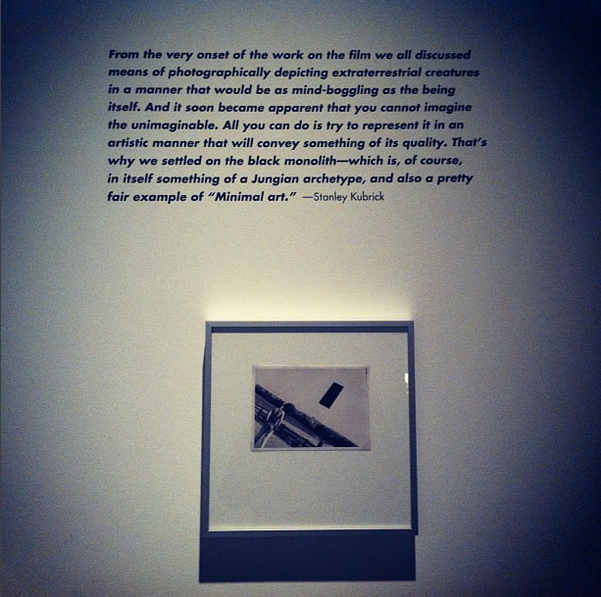
And then many years later, I saw this Stanley Kubrick quote at LACMA and was like, “Yes!”
 
“…it soon became apparent that you cannot imagine the unimaginable.” — Stanley Kubrick
We can only knit together what we already know in new ways to get to the something that’s never existed before.

Then, only in hindsight, can we look back and see that, nope, we never could have imagined the solution at the start.

And that’s what Design Thinking offers — a way to get where you’re going when you don’t know where that is.

So, what is the process of Design Thinking exactly?

Like anything, there’s complexity and layers of nuance to discover, but it can be pretty much summed up in four phases.

The 4 Phases of Design Thinking

1) Getting Focused: This is all about identifying constraints, and framing your challenge around the right questions (which probably aren’t the same questions you’ve been knocking your head against forever).

Less like: How can we stop drinking so much wine in front of the TV every night, OMG, we’re such losers!?

More like: How might we design activities at home that help us feel rewarded after a hard day of work?
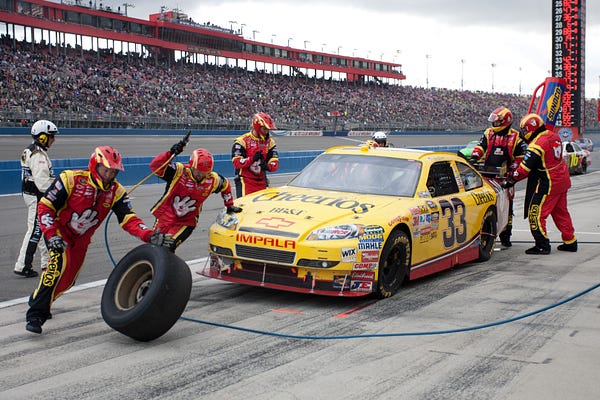
A famous example of looking to an analogous situation is the redesign of a hospital operating room that looked to a NASCAR pit crew for insights.

2) Getting Inspired: This is all about letting your curiosity guide you, and gaining empathy for the people you’re designing for (which could also be yourself). Become a detective of the world outside your own. You’re looking for clues about new ways of thinking and doing.
Talk to experts, people with extreme behaviors related to your challenge, and analogous situations that might provide unexpected answers. Go crazy, think broadly, have fun with it, be a little weird. This isn’t about finding the right answer. It’s about shaking things up and collecting a swirl of many potential answers.

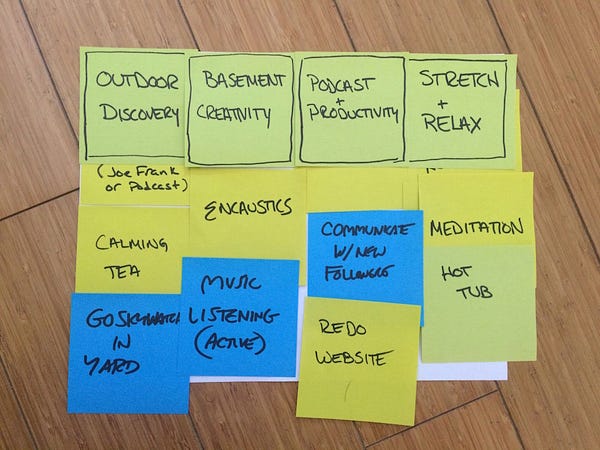
Getting Scrappy & Smarter Evening Routine-style: Brainstorm. Cluster. Prototype. Iterate.
3) Getting Scrappy: This is all about finding the patterns in your inspiration research, generating a whole lot of wild ideas, and creating lo-fi prototypes.

4) Getting Smarter: This is all about sharing your ideas with the people you’re designing for early and often, and testing and iterating your way towards a successful solution.

It helps when you’re just getting started to use these like you would training wheels, and to surround yourself with people who can do this kind of work in their sleep. But once you get practiced at it, you really don’t need to work through all the phases all the time, or do them in any particular order.

In fact, approaching the world through a designer’s lens becomes more of a mindset — one that is centered around:

· Curiosity: to seek out and see the world in new ways, especially through the eyes of other people. Empathy is an especially powerful tool, used in combination with your own design instincts.

· Optimism: to feel like every challenge is an opportunity for improvement, and that people (including you!) have the capacity to identify and solve seemingly impossible problems.

· Collaboration: to surround yourself with people whose brains and skills are different than yours so that you incorporate new perspectives and can get further faster, together.
One word of caution, like with all superpowers, you’ll sometimes resent experiencing the world with this newfound hyper-sensitivity.

Like when you’re at the airport at a United gate and everyone is asking everyone else if they’re standing in line 2 or 3 or what group is boarding, and people are bunched up against the moving sidewalk barriers and nobody walking by can get through and you’re like, “You can design this process to actually function if you wanted to, stupid f*cking United!”

By the way, that’s a good distinction to make: optimism doesn’t mean being cloyingly rose-colored. It just means you believe there’s room for improvement. And being design-minded just means you have the creative confidence that you are one of those people who can improve it.

I’m definitely optimistic that you can!

I’m also curious to hear what design challenges you’re interested in solving.

Share them here, and who knows, maybe there are others reading this that would be great collaborators on your new project.

If you want to experiment with applying design thinking to your own life, listen and subscribe to the Results May Vary podcast.
And if you enjoyed this article, please tap the heart below and share with someone you think would enjoy designing their lives more mindfully.


Sunday, January 3, 2016

Serendipity, Super Encounters, Observers, Sleuth Work, Communication etc...

 http://www.nytimes.com/2016/01/03/opinion/how-to-cultivate-the-art-of-serendipity.html?hpw&rref=sunday-review&action=click&pgtype=Homepage&module=well-region&region=bottom-well&WT.nav=bottom-well&_r=0

How to Cultivate the Art of Serendipity


DO some people have a special talent for serendipity? And if so, why?

In 2008, an inventor named Steve Hollinger lobbed a digital camera across his studio toward a pile of pillows. “I wasn’t trying to make an invention,” he said. “I was just playing.” As his camera flew, it recorded what most of us would call a bad photo. But when Mr. Hollinger peered at that blurry image, he saw new possibilities. Soon, he was building a throwable videocamera in the shape of a baseball, equipped with gyroscopes and sensors. The Squito (as he named it) could be rolled into a crawlspace or thrown across a river — providing a record of the world from all kinds of “nonhuman” perspectives. Today, Mr. Hollinger holds six patents related to throwable cameras.

A surprising number of the conveniences of modern life were invented when someone stumbled upon a discovery or capitalized on an accident: the microwave oven, safety glass, smoke detectors, artificial sweeteners, X-ray imaging. Many blockbuster drugs of the 20th century emerged because a lab worker picked up on the “wrong” information.

While researching breakthroughs like these, I began to wonder whether we can train ourselves to become more serendipitous. How do we cultivate the art of finding what we’re not seeking?
For decades, a University of Missouri information scientist named Sanda Erdelez has been asking that question. Growing up in Croatia, she developed a passion for losing herself in piles of books and yellowed manuscripts, hoping to be surprised. Dr. Erdelez told me that Croatian has no word to capture the thrill of the unexpected discovery, so she was delighted when — after moving to the United States on a Fulbright scholarship in the 1980s — she learned the English word “serendipity.”
Today we think of serendipity as something like dumb luck. But its original meaning was very different.

In 1754, a belle-lettrist named Horace Walpole retreated to a desk in his gaudy castle in Twickenham, in southwest London, and penned a letter. Walpole had been entranced by a Persian fairy tale about three princes from the Isle of Serendip who possess superpowers of observation. In his letter, Walpole suggested that this old tale contained a crucial idea about human genius: “As their highnesses travelled, they were always making discoveries, by accident and sagacity, of things which they were not in quest of.” And he proposed a new word — “serendipity” — to describe this princely talent for detective work. At its birth, serendipity meant a skill rather than a random stroke of good fortune.

Dr. Erdelez agrees with that definition. She sees serendipity as something people do. In the mid-1990s, she began a study of about 100 people to find out how they created their own serendipity, or failed to do so.

Her qualitative data — from surveys and interviews — showed that the subjects fell into three distinct groups. Some she called “non-encounterers”; they saw through a tight focus, a kind of chink hole, and they tended to stick to their to-do lists when searching for information rather than wandering off into the margins. Other people were “occasional encounterers,” who stumbled into moments of serendipity now and then. Most interesting were the “super-encounterers,” who reported that happy surprises popped up wherever they looked. The super-encounterers loved to spend an afternoon hunting through, say, a Victorian journal on cattle breeding, in part, because they counted on finding treasures in the oddest places. In fact, they were so addicted to prospecting that they would find information for friends and colleagues.
You become a super-encounterer, according to Dr. Erdelez, in part because you believe that you are one — it helps to assume that you possess special powers of perception, like an invisible set of antennas, that will lead you to clues.

A few months ago, I was having a drink in Cambridge, Mass., with a friend, a talented journalist who was piecing together a portrait of a secretive Wall Street wizard. “But I haven’t found the real story yet; I’m still gathering string,” my friend told me, invoking an old newsroom term to describe the first stage of reporting, when you’re looking for something that you can’t yet name. Later that night, as I walked home from the bar, I realized “gathering string” is just another way of talking about super-encountering. After all, “string” is the stuff that accumulates in a journalist’s pocket. It’s the note you jot down in your car after the interview, the knickknack you notice on someone’s shelf, or the anomaly that jumps out at you in Appendix B of an otherwise boring research study.

As I navigated the brick sidewalk, passing under the pinkish glow of a streetlight, I thought about how string was probably hiding all around me. A major story might lurk behind the Harvard zoology museum ahead or in the plane soaring above. String is everywhere for the taking, if you have the talent to take it.

In the 1960s, Gay Talese, then a young reporter, declared that “New York is a city of things unnoticed” and delegated himself to be the one who noticed. Thus, he transformed the Isle of Manhattan into the Isle of Serendip: He traced the perambulations of feral cats, cataloged shoeshine purveyors, tracked down statistics related to the bathrooms at Yankee Stadium and discovered a colony of ants at the top of the Empire State Building. He published his findings in a little book titled “New York: A Serendipiter’s Journey.”

The term “serendipiter” breathed new life into Walpole’s word, turning serendipity into a protagonist and a practitioner. After all, those ants at the top of the Empire State Building didn’t find themselves; Mr. Talese had to notice them, which was no easy matter. Similarly, Dr. Erdelez came up with the term super-encounterer to give us a way to talk about the people rather than just the discoveries. Without such words, we tend to become dazzled by the happy accident itself, to think of it as something that exists independent of an observer.

We can slip into a twisted logic in which we half-believe the penicillin picked Alexander Fleming to be its emissary, or that the moons of Jupiter wanted to be seen by Galileo. But discoveries are products of the human mind.

As people dredge the unknown, they are engaging in a highly creative act. What an inventor “finds” is always an expression of him- or herself. Martin Chalfie, who won a Nobel Prize for his work connected with green fluorescent protein — the stuff that makes jellyfish glow green — told me that he and several other Nobel Prize winners benefited from a chain of accidents and chance encounters on the way to their revelations. Some scientists even embrace a kind of “free jazz” method, he said, improvising as they go along: “I’ve heard of people getting good results after accidentally dropping their experimental preparations on the floor, picking them up, and working on them nonetheless,” he added.

So how many big ideas emerge from spills, crashes, failed experiments and blind stabs? One survey of patent holders (the PatVal study of European inventors, published in 2005) found that an incredible 50 percent of patents resulted from what could be described as a serendipitous process. Thousands of survey respondents reported that their idea evolved when they were working on an unrelated project — and often when they weren’t even trying to invent anything. This is why we need to know far more about the habits that transform a mistake into a breakthrough.

IN the late 1980s, Dr. John Eng, an endocrinologist, became curious about certain animal poisons that damaged the pancreas, so he ordered lizard venom through the mail and began to play around with it. As a result of this curious exercise, he discovered a new compound in the saliva of a Gila monster, and that in turn led to a treatment for diabetes. One of Dr. Eng’s associates (quoted in a 2005 newspaper article) remarked that he was capable of seeing “patterns that others don’t see.”
Is this pattern-finding ability similar to the artistic skill of a painter like Georgia O’Keeffe? Is it related to the string-gathering prowess of Gay Talese? We still know so little about creative observation that it’s impossible to answer such questions.

That’s why we need to develop a new, interdisciplinary field — call it serendipity studies — that can help us create a taxonomy of discoveries in the chemistry lab, the newsroom, the forest, the classroom, the particle accelerator and the hospital. By observing and documenting the many different “species” of super-encounterers, we might begin to understand their minds.

A number of pioneering scholars have already begun this work, but they seem to be doing so in their own silos and without much cross-talk. In a 2005 paper (“Serendipitous Insights Involving Nonhuman Primates”), two experts from the Washington National Primate Research Center in Seattle cataloged the chance encounters that yielded new insights from creatures like the pigtail macaque.

 Meanwhile, the authors of a paper titled “On the Exploitation of Serendipity in Drug Discovery” puzzled over the reasons the 1950s and ’60s saw a bonanza of breakthroughs in psychiatric medication, and why that run of serendipity ended. And in yet another field of study, a few information scientists are trying to understand the effects of being bombarded on social media sites with countless tantalizing pieces of “string.”

What could these researchers discover if they came together for one big conversation?

Of course, even if we do organize the study of serendipity, it will always be a whimsical undertaking, given that the phenomenon is difficult to define, amazingly variable and hard to capture in data. The clues will no doubt emerge where we least expect them, perhaps in the fungi clinging to the walls of parking garages or the mating habits of bird-watchers. The journey will be maddening, but the potential insights could be profound: One day we might be able to stumble upon new and better ways of getting lost.

Pagan Kennedy is the author of the forthcoming book “Inventology: How We Dream Up Things That Change The World.”
Follow The New York Times Opinion section on Facebook and Twitter, and sign up for the Opinion Today newsletter.

Pontiac School District & Oakland Schools ISD - Partnerships, Deals, Academics (FUTURE Learning Programs)

 http://tablet.olivesoftware.com/Olive/Tablet/DetroitFreePress/SharedArticle.aspx?href=DFP/2016/01/02&id=Ar00101

http://tablet.olivesoftware.com/Olive/Tablet/DetroitFreePress/SharedArticle.aspx?href=DFP/2016/01/02&id=Ar00407

Partnerships, deal save Pontiac’s K-12 district

State, county, teachers team up to bring down deficit, improve learning

On paper, the Pontiac School District appeared to be on the brink of collapse in 2013. The district’s massive deficit had ballooned from $38 million to $52 million in just one year. Bills weren’t getting paid. And residents were on the hook for a nearly $8-million court settlement.
But desperation has turned into hope in this district.

“Nobody wants to see this district dissolved and it’s not going to,” said Karen Jones-Thomas, a kindergarten teacher at the International Technology Academy. “It’s just like the city. We’re bouncing back.”

The district’s deficit has been whittled down to $33 million over the past two years, thanks largely to employees who took pay and benefit cuts, two big emergency loans from the state, property sales and cost-cutting.

But while the district is far from being financially healthy, the question on many minds is whether its path there — via a consent agreement with the state, a unique partnership with the Oakland County intermediate school district, and a plan to also address lagging achievement — might be a more viable and palatable option for school districts in a financial emergency.

It’s a timely question, considering the Michigan Department of Treasury this month will begin preliminary reviews of 11 school districts with deep financial troubles — reviews that could have the state finding them in a financial emergency. Pontiac is among five school districts previously identified.

But while the Detroit, Highland Park and Muskegon Heights school districts received emergency managers between 2009 and 2012 — Pontiac went a different route by choosing the consent agreement in 2013. The Benton Harbor Area Schools followed suit in 2014. An EM, after all, would mean the locally elected board of education would lose much of its power to govern the district. And it would provide almost unilateral power to one person.

The consent agreement process is far different. While the board doesn’t have full power and can be compelled to make decisions the state deems necessary, it still is in charge.

“It does keep all of the shareholders at the table talking,” said Don Weatherspoon, the man the state appointed to serve as a consultant for the agreement. Weatherspoon is also the emergency manager in the Highland Park school district and previously served as the EM in Muskegon Heights.

Brenda Carter, president of the Pontiac Board of Education, calls the consent agreement “a wise choice” because it gave the board “the opportunity to work with the state to help stabilize our school district.”

The agreement in Pontiac called for the board to contract with an outside agency to run key functions of the district. They chose Oakland Schools, the ISD for Oakland County, which is in charge of finance, human resources, technology and communications in the Pontiac district.
And while it could have mixed success in other districts, Weatherspoon said he’s impressed with what’s happened so far in Pontiac.

“By any measure, Pontiac is supposed to be gone,” Weatherspoon said. “The turnaround has been nothing short of remarkable.”

Some students say they’re noticing the change.

“There’s programs that are coming that are getting you ready for the future,” said Jose Ybarra, 16, an 11th-grader at the academy. “We’re rising slowly, but we’re still rising.”

They’re rising, said academy sophomore Dorian Kellam, 15, because “everybody is working hard to be on top. I think the district has gotten better.”

But the Pontiac district has a long way to go. State data released last month showed the Pontiac district is far worse off than many other districts in financial stress, with its $33-million deficit representing 46.66% of its revenue. Among traditional districts, only Benton Harbor was a higher deficit ratio, at 47%. Detroit Public Schools was at 32%.

Much of the district’s future is tied up in two proposals on the ballot in March. One asks voters to approve renewing 18 mills on non-homestead property, which generates more than $20 million in revenue for the district. The other asks voters to approve the creation of a sinking fund, a special fund that generates revenue to pay for major repair projects.

Two previous attempts to pass a sinking fund millage failed in 2015, and officials are hoping the third time will be the charm. The district includes the city of Pontiac and portions of nine surrounding communities. It’s in those surrounding communities where the district struggles to get support.
“It’s absolutely crucial,” Carter said. “With all the work we’ve done with raising student achievement and reducing our (deficit), we still need to maintain our buildings. Buildings are in disrepair.”
The last time the millage was before voters, it lost by 116 votes. It was encouraging news in the district.

Part of the long-standing financial problems in the district are tied to the failure to close buildings fast enough to address swiftly declining enrollment. The student population has shrunk from 7,287 in 2008 to 4,224 this school year. Meanwhile, frequent changes in administration left little consistency at the management level.

By the time current superintendent Kelley Williams became interim superintendent during the 2012-13 school year, the district’s financial situation was dire. An audit showed the deficit was $35 million. But just two weeks into the job, a new audit showed the deficit was dramatically worse, at $57 million. Williams, whose background is in curriculum and instruction, was alarmed.
“Everywhere I turned in the office there was a bill, a vendor calling on a daily basis asking for their payments,” Williams said.

The consent agreement, Williams said, “is the best thing we ever could have done.” But it hasn’t been easy. Egos had to be put aside. And some control was lost. In the end, she said, the bottom line was hashing out a plan that was in the best interests of students.

The district has sold 17 surplus properties, earning $5 million. It refinanced bonds and received two $10-million emergency loans from the state. And it had meetings with each vendor that was owed money, establishing a payment plan for paying that debt.

It also made a commitment to spend federal Title 1 grant dollars that go to schools with high populations of poor students. Nearly 80% of the district’s students are eligible for free or reduced-price lunch. The problem before the consent agreement? Only 23% of the money was getting spent, because the rule is schools must spend the money first, then get reimbursed later. When the money went unspent, it meant kids who need extra help the most weren’t getting it. Now, the district is spending 77% of that grant money, Williams said.

Employees have stepped up in difficult ways, too. In 2012, they took a 6% pay cut, then another 5.6% pay cut two years later, said Robert Moore, the deputy superintendent of finance and operations at Oakland Schools. On top of that, family insurance plans used to be paid by the district to the tune of $17,000 each, annually. The district now pays $10,000, while the employee pays the rest. A similar shift occurred for single and married insurance plans.

“Employees are paying a huge amount more for their benefits on top of having a more than 11% pay cut over two years. And they’re still working. The sacrifice ... is unparalleled,” Moore said.
Aimee McKeever, president of the Pontiac Education Association, said that despite the cuts, 168 of the 230 teachers who are part of her union were in the district prior to the consent agreement — a testament, she says, to their commitment to the district.

“I come here every day because I love it. Plain and simple,” said Chris Prentice, a ninth-grade social studies teacher who estimates he’s earning about $15,000 less annually between the pay cuts and the increase in insurance costs.

McKeever said one of the pros of the consent agreement is the addition of Oakland Schools, which has provided consistency for some key functions in the district, she said. But overall, she said she’d give the process a C-, because she doesn’t think there’s enough collaboration involving teachers.

“You need our input,” McKeever said.

Academic improvement key part of Pontiac’s plan

The Pontiac School District’s plan to eliminate a $33-million deficit also includes an ambitious plan to improve academic achievement in the district’s struggling schools.

The academic problem is serious: Students in the district have historically underperformed compared with the rest of the state on Michigan’s standardized exams. On the state’s new, rigorous exam, just 14% of students district-wide passed the English language arts portion, while 7.3% passed the math exam, according to data released in December.

To turn that around, the district — with help from Oakland Schools, the county’s intermediate school district — has adopted a myriad of new approaches since a consent agreement with the state was signed in September 2013.

That agreement includes an education plan that must be approved by the state superintendent and the state treasurer. The two must be intertwined, said Robert Moore, deputy superintendent of finance and operations for Oakland Schools, which is providing the Pontiac district with finance, human resources, technology and communications services on a contract basis.

“It’s very challenging to do that — making sure there’s enough horsepower in the budget to give the education plan the resources it needs,” Moore said.

So far, schools have shifted from a traditional September-to-June school year calendar to one that has students starting school in August and remaining in school through the end of June. They have the same holiday breaks other districts have, but Pontiac students also have two additional two-week breaks — one in October and the other in March.

How does that improve academic achievement? A shorter summer break cuts down on the amount of learning students lose during the traditional long summer break. And during those two-week breaks, the district holds intercessions that allow teachers to provide extra instruction to students who need it.
Superintendent Kelley Williams said the intercessions provide that extra help when it counts most.
“We can monitor when a student has not met the benchmarks, instead of waiting until the end of the school year,” Williams said. “We capture the intervention in the middle of the calendar.”

Meanwhile, teachers at the elementary level are providing an extra dose of reading and math instruction. And there’s a big emphasis on using technology at the middle and high school level, through the use of Chrome-books provided to each student, along with Internet access for students who don’t have it at home.

The infusion of technology required extensive training for teachers, helping them learn how to make the best use of it. The technology doesn’t replace the teacher, but it provides the teacher and student with a variety of resources to supplement learning, said Vickie Markavitch, CEO of cost-recovery field service at Oakland Schools.

“Teachers can go on there now and find tutorials, enrichment, extra practice, they can find colorful scenarios and simulations to help reinforce what normally would have been on a page,” Markavitch said. “It’s much more exciting, much more flexible, much more usable.”

Students seem to be liking the focus on technology. Oakland Schools surveys 10th-graders each year, gauging their satisfaction level with school and how engaged they are in their learning. In the past year, Pontiac students have made the greatest growth.

There are some other signs things are improving academically. On exams administered through the Northwest Evaluation Association, the percentage of students proficient on reading exams went from 18.7% to 23% from spring 2013 to spring 2014, Williams said. During the same time period, proficiency on math exams grew from 8% to 19.4%.

The district’s composite ACT score, though, has declined slightly, from 14.6 (out of 36) in the 2014-15 school year to 14.3 in 2014-15. But graduation rates are on the rise, from 59% in 2013-14 to 72% last school year, Williams said.

Contact Lori Higgins: lhiggins@freepress.com

Pontiac Recovery - Wall Street Journal (OU/Pontiac, Newsletter, Strand Theatre)

http://www.wsj.com/articles/troubled-pontiac-mich-looks-to-write-a-new-story-1450953062?mod=rss_US_News

Troubled Pontiac, Mich., Taps Interns to Augment City Hall

Rust Belt city shows signs of recovery, but bare-bones government staffing lingers after major cutbacks


In Pontiac, an artist’s rendering, center, of a 1920s-era performing arts theater that is being restored. Photo: Tim Galloway for The Wall Street Journal
PONTIAC, Mich.—When Mayor Deirdre Waterman wanted to trumpet the economic recovery of this city of 60,000, she couldn’t turn to a municipal public relations worker or community development staffer.

Those positions were wiped out by state-appointed emergency managers several years ago, when the city’s staff of more than 500 was cut to 30. Today most employees administer contracts for essential services such as policing and street cleaning that have been transferred to other districts or privatized.
Instead, Ms. Waterman tapped three interns from Oakland University 6 miles away in Rochester, Mich. The students produced a newsletter that was mailed to Pontiac’s 25,000 homes.

“Those jobs would have been done by city employees—if I had city employees to do that,” said Ms. Waterman, who works out of a nearly vacant City Hall overlooking a resurgent downtown.

The internship program with the university has given the mayor a de facto staff, and the students some real-world experience. But it also points to tensions among the mayor and city council, who have no party affiliations, and state-appointees in this recovering city where elected officials still have little control over daily functions.


The financial crisis has forced cities across the country to scale back. But the severe problems in some Michigan municipalities—already hard hit by the decline of the auto industry—forced cuts that struck at the heart of city government.

Detroit declared the largest municipal bankruptcy in U.S. history in 2013 and emerged from reorganization last year. Emergency Manager Kevyn Orr returned the reins of government to the mayor and city council soon after.

But Pontiac and five other Michigan municipalities, including Flint and Benton Harbor, still are overseen by transition advisory boards appointed by the governor. Pontiac’s board has four members who hold finance-related positions in local, county and state government.

Pontiac, which once had 85,000 residents and played host to the Detroit Lions in the soaring Silverdome, has endured trouble common across the Rust Belt. In addition to the Lions moving to Ford Field in Detroit, Pontiac also lost a total of nearly 3,000 jobs when General Motors shut a truck-assembly plant in 1994 and another in 2009. Today, many residents still work at other GM sites or for the county or a local hospital. Pontiac’s jobless rate was 10.7% in September.

Many residents moved away and property values declined, leaving abandoned houses, bloated expenses and sharply lower revenue. The city had three emergency managers between 2009 and 2013. The last one appointed Joseph Sobota as city administrator and he runs Pontiac on a daily basis.


State officials are now weighing whether to completely hand back power to the city—something Ms. Waterman is pressing. “I’m ready to go back to home rule,” she said.

Louis Schimmel, who served as emergency manager from 2011 to 2013, takes credit for the recovery and yet says it is still not time for business as usual in Pontiac.

Mr. Schimmel sold off the city’s sewage authority for $55 million and drastically cut city jobs. Moreover, he and a predecessor dissolved the police, firefighter and other unions using powers granted by the state’s emergency-manager law for financially stressed municipalities.

“I financially fixed the city big-time,” said Mr. Schimmel who still wields power as an advisory board member. “We don’t feel that we’re comfortable leaving right now, I can tell you that much.”
Today, Pontiac has a surplus of $10.8 million, or about 30% of its roughly $32 million budget, its third straight surplus. Revenues are rising as more residents are paying property taxes and the city has pushed to collect delinquent income taxes, officials said.


The Silverdome, pictured in October, was once home to the Detroit Lions. Photo: Tim Galloway for The Wall Street Journal 
 
Entrepreneurs and developers are returning. One is restoring a historic downtown theater. Another is building a $60 million facility on the site of a former GM plant where luxury-car enthusiasts can store their vehicles.

There are lingering tensions, however, at City Hall.

During a recent council meeting, members repeatedly sparred with Mr. Sobota, the city administrator. And several residents complained that Mr. Sobota and the previous emergency managers shortchanged the city. They said properties were sold off too cheaply and that the city doesn’t have enough firefighters under its contract with a nearby township.

One resident of Pontiac—which is 52% African-American, 27% white and 17% Hispanic—called Mr. Sobota, who is white, a “plantation overseer.”

“Democracy has left the city of Pontiac,” said Walter Moore, who was mayor in the 1980s and 1990s and wants the state to return control to the city. “Until that’s done, there will be no peace.” The criticism doesn’t faze him, Mr. Sobota said.


Ms. Waterman, an ophthalmologist who earns $100,000 a year as mayor, said she is focused on attracting new businesses and cleaning up blight. There are up to 1,000 vacant lots within the 20-square-mile city.

But on Saginaw Street, Pontiac’s main drag, business is picking up. On one end, a barbecue restaurant is expected to open soon next to a 1920s-era performing arts theater that is being restored. On the other end, the Lafayette Market, a brightly lighted space with a wine store and cafe, does a brisk lunch and catering business. “It’s starting to make a comeback,” Cheri Westberg, operations manager at the market, said of Pontiac.

In the inaugural edition of the city’s newsletter, Spirit of Pontiac, one article by journalism major Anthony Spak describes how vacant lots have been turned into community gardens, playgrounds and pocket parks, where neighbors can gather.

“It’s nice to be a part of something where you see the city changing, see it growing and becoming a place where people aren’t afraid to hang out,” Mr. Spak said in an interview.

Write to Kris Maher at kris.maher@wsj.com

Thursday, December 24, 2015

Towards MEANING MAKING in 2016...(Happy Holidays!) in 2016...


We’re Doomed. Now What?


We all see what’s happening, we read it in the headlines every day, but seeing isn’t believing, and believing isn’t accepting. We respond according to our prejudices, acting out of instinct, reflex and training. Right-wing denialists insist that climate change isn’t happening, or that it’s not caused by humans, or that the real problem is terrorism or refugees, while left-wing denialists insist that the problems are fixable, under our control, merely a matter of political will. Accelerationists argue that more technology is the answer. Incrementalists tell us to keep trusting the same institutions and leaders that have been failing us for decades. Activists say we have to fight, even if we’re sure to lose.

Meanwhile, as the gap between the future we’re entering and the future we once imagined grows ever wider, nihilism takes root in the shadow of our fear: if all is already lost, nothing matters anyway.
You can feel this nihilism in TV shows like “True Detective,” “The Leftovers,” “The Walking Dead” and “Game of Thrones,” and you can see it in the rush to war, sectarianism and racial hatred. It defines our current moment, though in truth it’s nothing new. The Western world has been grappling with radical nihilism since at least the 17th century, when scientific insights into human behavior began to undermine religious belief. Philosophers have struggled since to fill the gap between fact and meaning: Kant tried to reconcile empiricist determinism with God and Reason; Bergson and Peirce worked to merge Darwinian evolution and human creativity; more recent thinkers glean the stripped furrows neuroscience has left to logic and language.

Scientific materialism, taken to its extreme, threatens us with meaninglessness; if consciousness is reducible to the brain and our actions are determined not by will but by causes, then our values and beliefs are merely rationalizations for the things we were going to do anyway. Most people find this view of human life repugnant, if not incomprehensible.

In her recent book of essays, “The Givenness of Things,” Marilynne Robinson rejects the materialist view of consciousness, arguing for the existence of the human soul by insisting that the soul’s metaphysical character makes it impervious to materialist arguments. The soul, writes Robinson, is an intuition that “cannot be dispelled by proving the soul’s physicality, from which it is aloof by definition. And on these same grounds, its nonphysicality is no proof of its nonexistence.”
The biologist E.O. Wilson spins the problem differently: “Does free will exist?” he asks in “The Meaning of Human Existence.” “Yes, if not in ultimate reality, then at least in the operational sense necessary for sanity and thereby for the perpetuation of the human species.” Robinson offers an appeal to ignorance, Wilson an appeal to consequences; both arguments are fallacious.

Yet as Wilson suggests, our dogged insistence on free agency makes a kind of evolutionary sense. Indeed, humanity’s keenest evolutionary advantage has been its drive to create collective meaning. That drive is as ingenious as it is relentless, and it can find a way to make sense of despair, depression, catastrophe, genocide, war, disaster, plagues and even the humiliations of science.
Our drive to make meaning is powerful enough even to turn nihilism against itself. As Friedrich Nietzsche, one of Western philosophy’s most incisive diagnosticians of nihilism, wrote near the end of the 19th century: “Man will sooner will nothingness than not will.” This dense aphorism builds on one of the thoughts at the core of Nietzsche’s philosophy, today so widely accepted as to be almost unrecognizable, that human beings make their own meaning out of life.

When forced to the precipice of nihilism, we would choose meaningful self-annihilation over meaningless bare life.

In this view, there is no ultimate, transcendent moral truth — or, as Nietzsche put it in an early essay, “On Truth and Lies in a Nonmoral Sense,” truth is no more than a “mobile army of metaphors, metonyms, and anthropomorphisms.” If we can stomach the moral vertigo this idea might induce, we can also see how it’s not necessarily nihilistic, but in the right light a testament, rather, to human resilience.

The human ability to make meaning is so versatile, so powerful, that it can make almost any existence tolerable, even a life of unending suffering, so long as that life is woven into a bigger story that makes it meaningful. Humans have survived and thrived in some of the most inhospitable environments on Earth, from the deserts of Arabia to the ice fields of the Arctic, because of this ability to organize collective life around symbolic constellations of meaning: anirniit, capital, jihad. “If we have our own why in life,” Nietzsche wrote, “we shall get along with almost any how.”

When he wrote “Man will sooner will nothingness than not will,” Nietzsche was exposing the destructive side of humanity’s meaning-making drive. That drive is so powerful, Nietzsche’s saying, that when forced to the precipice of nihilism, we would choose meaningful self-annihilation over meaningless bare life. This insight was horrifically borne out in the Götterdämmerung of Nazi Germany, just as it’s being borne out today in every new suicide attack by jihadi terrorists — even as it’s being borne out here at home in our willfully destructive politics of rage. We risk it as we stumble toward another thoughtless war, asking young men and women to throw their lives away so we might continue believing America means something. As a character in Don DeLillo’s novel “White Noise” put it: “War is the form nostalgia takes when men are hard-pressed to say something good about their country”— which is to see war as an active nihilism supplanting a passive one.

Nietzsche wasn’t himself a nihilist. He developed his idea of truth as a “mobile army of metaphors” into a more complex philosophy of perspectivism, which conceived of subjective truth as a variety of constructions arising out of particular perspectives on objective reality. The more perspectives we learn to see from, the more truth we have access to. This is different from relativism, with which it’s often confused, which says that all truth is relative and there is no objective reality. Fundamentally, Nietzsche was an empiricist who believed that beyond all of our interpretations there was, at last, something we can call the world — even if we can never quite apprehend it objectively. “Even great spirits have only their five fingers breadth of experience,” he writes. “Just beyond it their thinking ceases and their endless empty space and stupidity begins.”

Nietzsche’s positive philosophical project, what he called his “gay science,” was to create the conditions for the possibility of a human being who could comprehend the meaninglessness of our drive to make meaning, yet nonetheless affirm human existence, a human being who could learn “amor fati,” the love of one’s fate: this was his much-misunderstood idea of the “overman.” Nietzsche labored mightily to create this new human ideal for philosophy because he needed it so badly himself. A gloomy, sensitive pessimist and self-declared decadent who eventually went mad, he struggled all his life to convince himself that his life was worth living.

Today, as every hour brings new alarms of war and climate disaster, we might wish we could take Nietzsche’s place. He had to cope only with the death of God, after all, while we must come to terms with the death of our world. Peril lurks on every side, from the delusions of hope to the fury of reaction, from the despondency of hopelessness to the promise of destruction. 

We stand today on a precipice of annihilation that Nietzsche could not have even imagined. There is little reason to hope that we’ll be able to slow down global warming before we pass a tipping point. We’re already one degree Celsius above preindustrial temperatures and there’s another half a degree baked in. The West Antarctic ice sheet is collapsing, Greenland is melting, permafrost across the world is liquefying, and methane has been detected leaking from sea floors and Siberian craters: it’s probably already too late to stop these feedbacks, which means it’s probably already too late to stop apocalyptic planetary warming. Meanwhile the world slides into hate-filled, bloody havoc, like the last act of a particularly ugly Shakespearean tragedy.

Accepting our situation could easily be confused with nihilism. In a nation founded on hope, built with “can do” Yankee grit, and bedazzled by its own technological wizardry, the very idea that something might be beyond our power or that humans have intrinsic limits verges on blasphemy. Right and left, millions of Americans believe that every problem has a solution; suggesting otherwise stirs a deep and often hostile resistance. It’s not so much that accepting the truth of our situation means thinking the wrong thought, but rather thinking the unthinkable.

Yet it’s at just this moment of crisis that our human drive to make meaning reappears as our only salvation … if we’re willing to reflect consciously on the ways we make life meaningful — on how we decide what is good, what our goals are, what’s worth living or dying for, and what we do every day, day to day, and how we do it. Because if it’s true that we make our lives meaningful ourselves and not through revealed wisdom handed down by God or the Market or History, then it’s also true that we hold within ourselves the power to change our lives — wholly, utterly — by changing what our lives mean. Our drive to make meaning is more powerful than oil, the atom, and the market, and it’s up to us to harness that power to secure the future of the human species.

We can’t do it by clinging to the progressivist, profit-seeking, technology-can-fix-it ideology of fossil-fueled capitalism. We can’t do it by trying to control the future. We need to learn to let our current civilization die, to accept our mortality and practice humility. We need to work together to transform a global order of meaning focused on accumulation into a new order of meaning that knows the value of limits, transience and restraint.

Most important, we need to give up defending and protecting our truth, our perspective, our Western values, and understand that truth is found not in one perspective but in their multiplication, not in one point of view but in the aggregate, not in opposition but in the whole. We need to learn to see not just with Western eyes but with Islamic eyes and Inuit eyes, not just with human eyes but with golden-cheeked warbler eyes, coho salmon eyes, and polar bear eyes, and not even just with eyes at all but with the wild, barely articulate being of clouds and seas and rocks and trees and stars.

We were born on the eve of what may be the human world’s greatest catastrophe. None of us chose this, not deliberately. None of us can choose to avoid it either. Some of us will even live through it. What meaning we pass on to the future will depend on how well we remember those who have come before us, how wisely and how gently we’re able to shed the ruinous way of life that’s destroying us today, and how consciously we’re able to affirm our role as creators of our fated future. 

Accepting the fatality of our situation isn’t nihilism, but rather the necessary first step in forging a new way of life. Between self-destruction and giving up, between willing nothingness and not willing, there is another choice: willing our fate. Conscious self-creation. We owe it to the generations whose futures we’ve burned and wasted to build a bridge, to be a bridge, to connect the diverse human traditions of meaning-making in our past to those survivors, children of the Anthropocene, who will build a new world among our ruins.

Related: “Learning How to Die in the Anthropocene”
Roy Scranton is the author of “Learning to Die in the Anthropocene: Reflections on the End of a Civilization” and the forthcoming novel “War Porn,” and is a co-editor of “Fire and Forget: Short Stories from the Long War.” He has written for The New York Times, The Nation, Theory & Event, Rolling Stone and elsewhere. Twitter @RoyScranton.